How to Specify and Inspect Epoxy Coated Pipe to Avoid Field Problems
Epoxy coated pipe is one of those products where the gap between a good installation and a problematic one often comes down to specification and receiving inspection rather than anything that happens during production. The coating itself is reliable when it’s applied correctly and specified precisely. The field problems — premature corrosion, coating delamination, pinhole failures — usually trace back to underspecification at the purchase order stage or insufficient inspection when the material arrives.
Here’s how to close those gaps.
Write a Specification That Actually Constrains What You Receive
A purchase order that says “epoxy coated pipe” is not a specification. It’s a category. Without more detail, you’ll receive whatever the supplier’s default product is — which may or may not be appropriate for your application.
A useful specification for epoxy coated pipe covers at minimum:
Coating standard. The two most commonly referenced standards for epoxy pipe coating are AWWA C210 (for liquid-applied epoxy lining) and AWWA C213 (for fusion-bonded epoxy). There are others depending on the application. Specifying a standard ensures the coating meets defined requirements for material composition, surface preparation, application method, and testing.
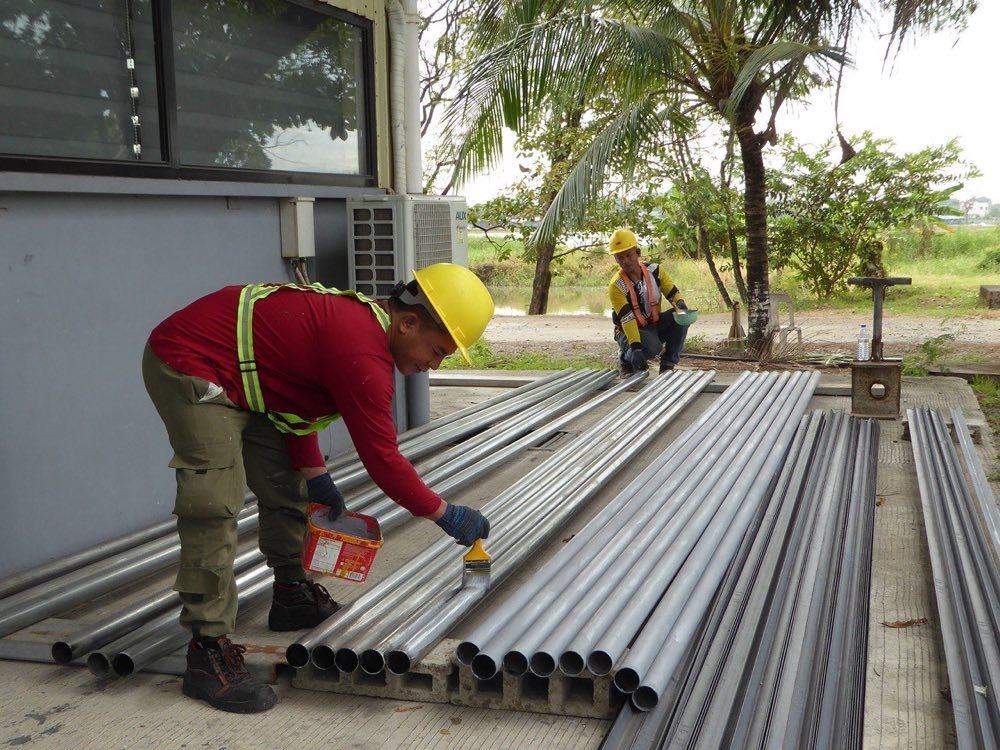
Coating type. Liquid-applied epoxy and fusion-bonded epoxy (FBE) are different products with different characteristics. FBE, applied as a powder and cured by heat, generally offers better adhesion and more uniform coverage. Liquid epoxy is applied by spray or brush and is common for field repairs and for coating the interior of large-diameter pipe. Which one is appropriate depends on the service and the pipe size.
Dry film thickness (DFT). Specify the minimum and maximum acceptable dry film thickness in mils or microns. Coating that’s too thin doesn’t provide adequate barrier protection; coating that’s excessively thick can be brittle and prone to cracking. The coating manufacturer’s data sheet will give recommended ranges for the specific product.
Surface preparation. Coating adhesion depends heavily on surface preparation. Specify the required blast cleaning standard — typically SSPC-SP 10 (Near-White Blast Cleaning) or SSPC-SP 6 (Commercial Blast Cleaning) — and the required surface profile. Under-prepared surfaces are a leading cause of coating failure in service.
Holiday testing. A holiday is a pinhole or discontinuity in the coating that allows the base metal to contact the service fluid. Specify that 100% holiday detection testing is required, and reference the applicable test method (typically NACE SP0188 for immersion service).
What to Check When the Pipe Arrives
Receiving inspection for epoxy coated pipe takes more time than for bare pipe, but it’s where specification requirements get verified before the material goes into the ground or into a system.
Visual inspection. Walk the delivery and look at the coating surface on every pipe. What you’re looking for: uniform color and gloss (inconsistency suggests uneven application or curing problems), no visible holidays, blisters, runs, or sags in the coating, and no mechanical damage from handling during transport. The ends of the pipe — where cut-back zones leave bare metal exposed for field welding — should be clearly defined and protected.
Dry film thickness measurement. Use a calibrated magnetic dry film thickness gauge to measure coating thickness at multiple points around the circumference and along the length of representative lengths. Check the measurements against the specified DFT range. Readings consistently below the minimum or above the maximum are a non-conformance.
Holiday detection. If the specification requires holiday testing and the supplier hasn’t done it, request a holiday test on received material before acceptance. If they have done it, ask for the test records. Holiday testing results should be documented as part of the material package.
End protection. Epoxy Coated Pipe is typically supplied with bare metal cut-back zones at each end to allow field welding. These bare zones should be protected during shipping and storage to prevent rust. If they arrive with significant corrosion on the cut-back zones, the surface preparation required before field welding gets more complicated and adds cost.
Handling and Storage After Delivery
Coating damage during handling and storage is common and often avoidable. A few things that matter:
Use padded slings or wide nylon straps when lifting coated pipe — wire rope or chain will damage the coating. Keep spacers or padding between stacked lengths to prevent the coating on one length from being abraded by the next. Store coated pipe off the ground on padded supports.
For pipe stored outdoors for extended periods, check the coating condition periodically. UV degradation is a concern with some epoxy formulations over long exposure, and any damage to the coating during storage should be documented and repaired before installation.
Field Welding and Repair
The cut-back zones at each pipe end leave bare metal that gets welded in the field. After welding, the exposed area — including the weld, heat-affected zone, and adjacent areas where the factory coating may have been damaged by welding heat — needs to be repaired with a compatible field-applied coating.
Specify what the repair coating should be and how it should be applied. It should be compatible with the factory-applied coating, applied to a properly prepared surface (blast or power tool clean as appropriate), and tested for holiday-free coverage after application.
Unrepaired or poorly repaired weld zones are where corrosion failures initiate in coated piping systems. The repair step is part of the corrosion protection system, not an optional finishing touch.
Documentation to Request
At a minimum, request the following documentation with any epoxy coated pipe delivery:
- Coating material data sheets confirming the product used matches the specification
- Surface preparation records (blast profile measurements, blast standard achieved)
- DFT test records showing measurements for each pipe length
- Holiday test records
- Mill certificates for the base pipe material
A supplier who can’t produce complete documentation for a coated pipe delivery is a supplier whose quality controls aren’t where they need to be for a product where the coating is the whole point of the specification.
The specification and inspection work upfront adds time to the procurement process. It costs considerably less than dealing with early coating failures in an installed system.